Monday, April 6, 2009

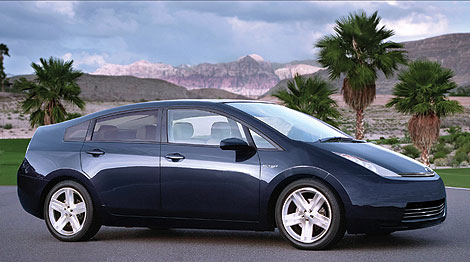
Toyota Sells Millionth Hybrid Pictures


June 7, 2007 - Toyota Motor Sales (TMS), U.S.A., Inc., announced the one-millionth hybrid sale today by parent company, Toyota Motor Corporation. Of the one million hybrid sales worldwide, more than half have been sold in the United States — 541,210 units from 2000 through April 2007.


June 7, 2007 - Toyota Motor Sales (TMS), U.S.A., Inc., announced the one-millionth hybrid sale today by parent company, Toyota Motor Corporation. Of the one million hybrid sales worldwide, more than half have been sold in the United States — 541,210 units from 2000 through April 2007.

“The cost benefit of hybrids is becoming more apparent with climbing gas prices,” said Jim Lentz, TMS executive vice president. “We anticipate combined sales of Toyota and Lexus hybrids of a quarter million units in the U.S. during calendar year 2007.”

Despite earlier concerns that decreased tax credits from the IRS would dampen hybrid demand, Toyota continues to post record hybrid sales. Calendar-year-to-date hybrid sales for TMS totaled 119,154 units, an increase of 75 percent over the same period last year.

In May, TMS posted sales of 36,101 hybrid vehicles, up 102 percent over last May. Toyota Division posted sales of 34,174 hybrids, up 121 percent over the same period last year. Lexus Division posted sales of 1,927 hybrids.

As consumers begin the summer driving season, the broad benefits of hybrid technology reveal discernible cost-savings with strong sales of Toyota Camry Hybrid and Toyota Prius.

Aside from the gas-savings to hybrid owners, the significant reduction in tailpipe emissions, as well as the reduction in foreign oil dependence, has been a factor among many buyers who say they are concerned about the environment. According to a recent study by the National Renewable Energy Laboratory (NREL), hybrid vehicles have saved close to 215 million gallons, or 5.1 million barrels, of fuel in the U.S. since their introduction in 1999. As the market share leader in the hybrid segment, Toyota accounted for 66 percent of all hybrids sold in America during that period.

Additionally, Toyota has calculated that global sales of hybrid vehicles have greatly contributed to reductions in CO2 emissions. Since the introduction of Toyota’s first hybrid in 1997, approximately 3.5 million fewer tons of CO2 were emitted when comparing emissions from gas-powered vehicles to hybrids of the same class.

Also significant to buyers who may base their next purchase on environmental priorities are the results of recent lifecycle assessment studies of hybrid vehicles. A variety of studies, including one from the Argonne National Laboratory, have concluded that the total lifetime energy use of hybrid vehicles—from development, through production, through on-highway use, to end-of-life recycling and landfill—is significantly lower than conventional vehicles.

Prius was launched in the Japan domestic market in 1997, and in the U.S. market as a 2001-model in 2000. In 2005, the Highlander Hybrid SUV debuted as a model year 2006. For the first time, the Toyota Camry added a hybrid option for model year 2007.

In 2005 Lexus entered the hybrid fold with the launch of the world’s first luxury hybrid, the RX 400h luxury sport utility vehicle. Powered by its Lexus Hybrid Drive system, the RX 400h is equipped with a 3.3-liter V6 and two electric motor generators, delivering an impressive 268 total system horsepower while rated an EPA estimate of 32 miles-per-gallon during city driving. The new hybrid luxury SUV has proved popular with environmentally-conscious luxury buyers as the RX 400h has made up nearly 20 percent of all RX sales since it launched.

Lexus continued its venture into hybrids in 2006 with the launch of the GS 450h performance luxury sedan. The GS450h gave further proof that hybrid technology could be used in many different types of vehicles.

The Lexus commitment to hybrid technology continues with the launch of the all-new 2008 LS 600h L premium luxury hybrid sedan when it goes on sale this summer.

Article by. Joel in http://www.thecarblog.com/

Saturday, April 4, 2009

Chevrolet Nubira Sedan

Chevrolet CruzeChevrolet LacettiChevrolet Nubira SedanChevrolet Aveo SedanChevrolet AveoChevrolet HHRChevrolet EpicaChevrolet Nubira SWChevrolet VoltChevrolet CamaroChevrolet CaptivaChevrolet SparkChevrolet MatizThe Chevrolet Nubira Sedan is measuring 4.5 m long. It is available with two petrol engines (109 or 122 hp) or a Diesel (121 hp), manual or automatic, and three trim levels. There is also

Chevrolet Aveo Sedan

Chevrolet CruzeChevrolet LacettiChevrolet Nubira SedanChevrolet Aveo SedanChevrolet AveoChevrolet HHRChevrolet EpicaChevrolet Nubira SWChevrolet VoltChevrolet CamaroChevrolet CaptivaChevrolet SparkChevrolet MatizThe Chevrolet Aveo Sedan is a 4.3 m long and four-door body. It has a gasoline engine of 94 HP, replaces the Kalos car with four doors. The Kalos three-or five-door selling is still

Chevrolet Aveo

Chevrolet CruzeChevrolet LacettiChevrolet Nubira SedanChevrolet Aveo SedanChevrolet AveoChevrolet HHRChevrolet EpicaChevrolet Nubira SWChevrolet VoltChevrolet CamaroChevrolet CaptivaChevrolet SparkChevrolet MatizThe Chevrolet Aveo is available with a body of three, four or five doors. Can be purchased from 8500 € with two different gasoline engines. There is no diesel version.Chevrolet AveoUntil

Friday, April 3, 2009

2010 Audi R8 5.2 V10 FSI Quattro Road Test

A bigger stick for the soft-spoken supercar, and a price to match.

By making available an R8 with a monster 525-hp V-10 engine—complementing the 420-hp V-8 model that was introduced two years ago—Audi has elevated its exotic-looking two-seater from “almost-a-supercar” status to a true competitor in the high-performance realm above mere sports cars.

The 105-hp increase comes from a 5.2-liter, direct-injection V-10 that is virtually identical to the engine found in the Lambor ghini Gallardo LP560-4.

Unique engine programming and intake and exhaust systems are the chief differences in the Audi engine over the Italian job, although both engines are made in the same plant in Hungary.

We’re told that the V-10 weighs just 68 pounds more than the V-8, and that fuel economy with the bigger engine will worsen by only 1 mpg.

Output is listed by Audi at 525 horsepower and 391 pound-feet of torque, 27 horses and seven pound-feet fewer than in the Lambo, but we suspect some of that difference is simply marketing.

With the help of launch control, a first for the R8’s manual transmission, we managed the 0-to-60 dash in 3.7 seconds and a quarter-mile in 11.8 seconds at 121 mph.

That’s a full second quicker in the quarter-mile than we recorded in a manual-transmission V-8 R8 and dead even with a Porsche 911 GT2. This was measured in a down-and-dirty test run during a preview drive in Spain.

Lamborghini owners need not fret that this R8 will steal the Gallardo’s thunder, as the V-10 R8’s numbers are quite a few ticks behind those of the automated-manual LP560-4 we tested in February.

A more formal test with the paddle-shifted transmission should improve our times, but still, we don’t see a lot of cross-shopping between these corporate cousins.

The Lamborghini is a car for extroverts—loud, brash, in your face. The Audi is more of a speak-softly-and-carry-a-big-stick car. The exhaust—quiet during relaxed driving and escalating in volume above 4000 rpm—never fully intrudes on the serenity in the cockpit until you approach the 8700-rpm redline (700 more than the V-8’s and 200 higher than the Lambo’s).

The extra oomph is obvious as soon as the R8 5.2 starts moving, but the power increase hasn’t upset the R8’s user-friendliness and neutral handling. Easy driving is still the name of the game; both models have graceful manners even when driven hard around a track.

Visual differences between V-8 and V-10 R8s are slight. The V-10 model has wider intakes behind the doors, which sit atop wider body sills. In front and back, the black accents are glossy instead of flat, and there are two crossbraces to the air intake rather than three.

The V-10 R8’s exhaust tips are larger and oval-shaped, and this model also sports standard LED lighting, previously an option. The seats, a carry-over from the V-8 model, had us at times wishing for more lateral support.

We’re pleased the R8’s optional ceramic brakes might make it to North America. They’re strong, completely free of fade, and—unlike the on-off brakes in the Gallardo—can actually be modulated for smooth driving.

Audi won’t pinpoint when the V-10 R8 will go on sale or what it will cost. We’ll bet on late this year at the earliest, with a premium of maybe $45,000 over the V-8 R8’s $117,500 base price.

凯雷德Hybrid惊现国内

凯迪拉克凯雷德Hybrid,作为当今全球汽车混合动力技术最高成就的代表,自去年北京车展首度亮相后就一直备受各界关注,而关于这款车何时在国内上市的各种传言也显示了广大车迷们对它的期待心理。

近日随着上海车展的日益临近,一款白色凯雷德Hybrid惊现国内某片场,这似乎预示着Hybrid技术加身的凯雷德混合动力版已经离中国消费者越来越近了。

谍照显示,这款Hybrid车型除了车身标有明显的“Hybrid”字样之外,外观上与在售普通版凯雷德没有太大差异。凯雷德Hybrid搭载6.0升V8发动机,并且还搭载一个先进的电控变速系统(EVT)和一个安装在车体中部的扁平化的300伏镍金属氢化物电池组。动力方面,最大功率达332马力,最大扭矩可达497N·m。

在高速巡航的状态下,该发动机能够关闭一半的汽缸运作,而在低速时,除了可使用电动马达来驱动之外,也能够以四缸模式实现经济运转。这款混合动力车型的耗油量比传统的大型SUV节省50%之多,甚至低于市面上普通六缸轿车的油耗,加一次油可以比普通款SUV增加一倍的续航里程。

『现款凯雷德』

谍照里露面的这辆凯雷德极有可能是将在4月的上海车展上亮相的实车,而此次凯雷德Hybrid在国内的第二次亮相。更多消息我们将继续关注,为您及时报道。

The Maserati Quattroprte Sport GT

If you are looking for a car that is going to blow you away, then you can not go wrong with the Maserati Quattroprte Sport GT, 2009 model.Now, when you first see this car you will think that it looks a lot like the Quattroprte S model. This is because of the chrome logo and red accents, as well as the nice black finish with just all the right trims. However, this car has so much more to it than